
Rembrandt Paintings at the Rijksmuseum (2026): Every Work & Location
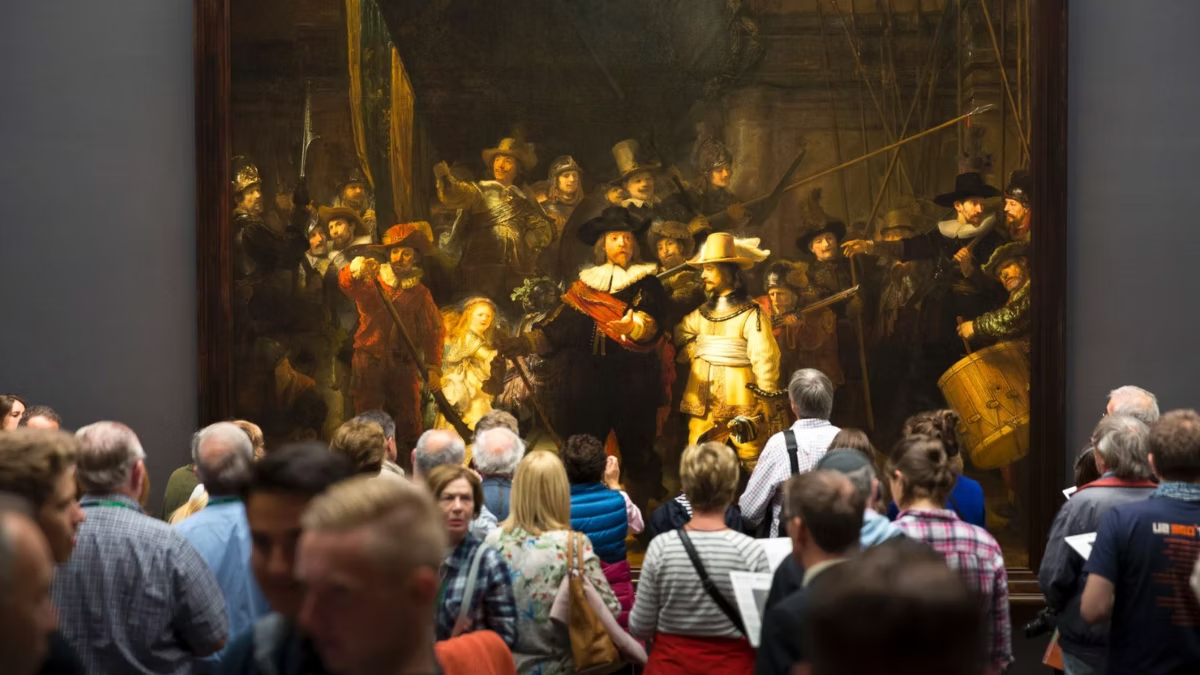
The Rijksmuseum holds the largest collection of Rembrandt paintings in the world, with around 22 authenticated Rembrandt works on display across Floor 2. The most famous are The Night Watch (1642) in its own room (2.30), The Jewish Bride (c. 1665), The Syndics (1662), and Self-Portrait as the Apostle Paul (1661) in the Gallery of Honour, and the young self-portrait (c. 1628) in Room 2.8. Other important works include The Anatomy Lesson of Dr Deijman, Titus as a Monk, Isaac and Rebecca (The Jewish Bride), and several biblical and mythological scenes. All Rembrandts are included with standard Rijksmuseum entry (€25 adult, free under 18). This guide maps every major work to its location with what to look for.
Rembrandt van Rijn (1606-1669) is the central artist at the Rijksmuseum — the museum was built in part around his works, and the Gallery of Honour culminates architecturally at The Night Watch. Whether you’re a serious art lover planning a Rembrandt-focused visit or just want to see everything he painted at the museum, this guide covers all 22 paintings, where each hangs, and what makes each one worth your time.
How Many Rembrandts Are at the Rijksmuseum?
The Rijksmuseum holds approximately 22 authenticated Rembrandt paintings on display, making it the largest permanent Rembrandt collection in any single museum. Additional works attributed to Rembrandt’s workshop (paintings by his students made under his supervision) bring the total closer to 30 if you count these. The museum also holds hundreds of Rembrandt etchings and drawings in its paper-works collection, most kept in storage and rotated through special exhibitions.
Where Rembrandt’s paintings hang
All major Rembrandts are on Floor 2, mostly in or adjacent to the Gallery of Honour. A few are in the rooms immediately outside the Gallery of Honour on the same floor. None of the major Rembrandts are on Floor 0, 1, or 3.
The attribution question
Rembrandt ran one of the largest painting workshops of his era, with dozens of students (including Carel Fabritius, Govert Flinck, and Ferdinand Bol) who worked in his style. Many paintings once attributed to Rembrandt have been reattributed to his students or workshop over the past century. The Rijksmuseum’s current Rembrandt count reflects current scholarship — which has tightened over the decades as scholars like the Rembrandt Research Project re-examined works.
The count I’m using (22) refers to paintings currently attributed to Rembrandt himself, not his workshop. If you include workshop pieces and Rembrandt-circle works, the number rises to around 30.
The Five Most Famous Rembrandts at the Rijksmuseum
These are the works you should prioritize if you’re short on time. All hang in the Gallery of Honour or its immediate vicinity on Floor 2.
1. The Night Watch (1642)
Location: Night Watch Room (2.30), at the far end of the Gallery of Honour.
The painting that made Rembrandt’s reputation and the museum’s most famous work. Monumental group portrait of an Amsterdam militia company, 363 × 437 cm. Currently undergoing Operation Night Watch — the largest restoration project in its history, with conservators visible behind a glass chamber.
See our full guide: The Night Watch by Rembrandt.
2. The Jewish Bride (Isaac and Rebecca) (c. 1665-1669)
Location: Gallery of Honour, Rembrandt alcove.
One of Rembrandt’s greatest late works. A couple in tender, intimate embrace — traditionally called “The Jewish Bride” based on a 19th-century misattribution; now believed to depict the biblical couple Isaac and Rebecca. Van Gogh reportedly said he’d “give 10 years of his life” to sit for two weeks in front of it.
What to look for: The impasto — thick paint applied with palette knife on the sleeve and jewellery. You can physically see the texture from close up. This technique is what made Rembrandt’s late style so influential on later artists like Manet and Monet.
3. The Syndics (The Sampling Officials) (1662)
Location: Gallery of Honour, Rembrandt alcove.
Group portrait of five men who governed the Amsterdam cloth-makers’ guild — painted 20 years after The Night Watch with a completely different compositional approach. All five men seem to be caught mid-gesture, as if the viewer has walked into a meeting.
What to look for: The sixth figure in the background (a servant), easily missed. Rembrandt’s ability to make a formal group portrait feel captured rather than posed.
4. Self-Portrait as the Apostle Paul (1661)
Location: Gallery of Honour, Rembrandt alcove.
Rembrandt painted roughly 80 self-portraits across his career — more than any other major European artist of the period. This one shows him at age 55, depicted as the biblical apostle Paul, holding an epistle.
What to look for: Rembrandt’s face — weathered, introspective, a world away from the confident young man in the earlier self-portrait (Room 2.8). Seeing the two together, 33 years apart, is one of the Rijksmuseum’s quiet revelations.
5. Self-Portrait (c. 1628)
Location: Room 2.8.
Young Rembrandt at age 22, painted when he was still an ambitious provincial artist from Leiden. The contrast with the Apostle Paul self-portrait is the entire story of his career in two paintings.
What to look for: The dramatic back-lighting (a technique he used throughout his career) and the youthful uncertainty in the expression — his mature confidence hadn’t yet arrived.
Other Important Rembrandts
Beyond the “big five,” these additional Rembrandts are on permanent display and well worth seeing:
The Anatomy Lesson of Dr Deijman (1656)
Location: Near Gallery of Honour.
Surviving fragment of what was once a much larger group portrait destroyed by fire in 1723. Only the head and shoulders of the cadaver and one attending doctor remain. Gruesome but artistically extraordinary — the exposed brain is painted with astonishing precision.
Portrait of Marten Soolmans (1634)
Location: Gallery of Honour.
A wedding-commission portrait of a wealthy Amsterdam merchant. Part of a pair — his wife Oopjen Coppit’s portrait hangs nearby. The Rijksmuseum jointly acquired both paintings with the Louvre in 2015 for €160 million, one of the most expensive art purchases ever made — and the two museums now share custody, alternating between Amsterdam and Paris.
Portrait of Oopjen Coppit (1634)
Location: Gallery of Honour (when in Amsterdam).
Pair to Marten Soolmans. Jointly owned with the Louvre. Check before visiting whether she’s currently at the Rijksmuseum or in Paris — the two paintings move between the institutions on a schedule.
Isaac and Rebecca Spied on by Abimelech (1665)
Location: Gallery of Honour area.
A late biblical painting with Rembrandt’s characteristic warm, painterly surface.
The Stone Bridge (c. 1638)
Location: Gallery of Honour area.
One of only a handful of Rembrandt landscape paintings. Most Rembrandt landscapes survive as drawings or etchings; this oil is a rarity.
Titus as a Monk (1660)
Location: Varies — sometimes Gallery of Honour, sometimes side rooms.
Rembrandt’s son Titus, painted as a monk in contemplation. Titus died at age 26, a year before his father — the paintings of him are emotionally charged given this context.
Hendrickje Stoffels (c. 1654)
Location: Side rooms on Floor 2.
Portrait of Rembrandt’s second partner (he never married her). Hendrickje features in several of his late paintings and was the emotional centre of his final years.
The Feast of Esther (c. 1660) — contested attribution
Sometimes attributed to Rembrandt, sometimes to his student Gerrit Dou. Scholars remain divided. If you see it labelled in the museum, note the attribution designation.
A Rembrandt-Focused Route Through the Museum
For visitors wanting to see the main Rembrandts in one efficient sweep:
- Enter Floor 2 via the Great Hall
- Walk straight to the Night Watch Room at the far end — spend 10-15 minutes with The Night Watch
- Return through the Gallery of Honour slowly, stopping at the Rembrandt alcove for The Jewish Bride, The Syndics, and Self-Portrait as the Apostle Paul
- Visit Room 2.8 for the young self-portrait
- Loop through adjacent rooms for The Anatomy Lesson of Dr Deijman and other Rembrandts
Total time: 90 minutes to 2 hours for a proper Rembrandt deep-dive. See Rijksmuseum Floor Plan & Map for navigation.
Understanding Rembrandt’s Style Across Career Stages
One of the great pleasures of the Rijksmuseum collection is being able to trace Rembrandt’s artistic evolution in one museum. The collection spans his career from his early 20s to the year of his death.
Early Rembrandt (c. 1628-1635)
Key work at the Rijksmuseum: Young Self-Portrait (Room 2.8)
Characteristics: Dramatic lighting, tight detail, relatively polished surface. Still learning his mature style. Influenced by his teacher Pieter Lastman.
Peak Rembrandt (c. 1635-1650)
Key work at the Rijksmuseum: The Night Watch (1642), Marten Soolmans / Oopjen Coppit portraits (1634)
Characteristics: Grand-scale commissions, virtuoso technique, confident handling of light and composition. Financial peak of his career.
Late Rembrandt (c. 1650-1669)
Key works at the Rijksmuseum: The Jewish Bride, The Syndics, Self-Portrait as the Apostle Paul, The Anatomy Lesson of Dr Deijman
Characteristics: Looser brushwork, heavier impasto, darker palette, more emotionally complex subjects. Financial collapse (bankruptcy in 1656) and personal losses (deaths of his partner Hendrickje in 1663 and son Titus in 1668) shape these works. Many scholars consider this the greatest phase of his career.
Rembrandt Elsewhere in Amsterdam
If you want a fuller Rembrandt experience beyond the Rijksmuseum:
- Rembrandt House Museum — the actual house where he lived and worked from 1639 to 1658, preserved as it was during his lifetime. See Rijksmuseum + Rembrandt House Combo Tour.
- Amsterdam Museum — holds some Rembrandt works connected to city history
- The Jewish Historical Museum — has Rembrandts with Jewish-themed subjects
Outside Amsterdam, major Rembrandt holdings are at:
- Mauritshuis, The Hague — 11 Rembrandts including The Anatomy Lesson of Dr Tulp
- Louvre, Paris — holds the other half of the Marten Soolmans/Oopjen Coppit joint collection
- Hermitage, St Petersburg — the second-largest Rembrandt collection, with 23 paintings
- Metropolitan Museum of Art, New York — 18 Rembrandts
- National Gallery, London — 10 Rembrandts
Operation Night Watch: The Living Restoration
You can’t write about Rembrandt at the Rijksmuseum without mentioning Operation Night Watch — the ongoing restoration and study of his most famous painting, running since 2019.
Key things to know:
- The painting is fully visible during the restoration — you don’t need to miss out
- Conservators work in a glass chamber — you’ll often see them on the canvas during your visit
- Hyperspectral imaging, X-ray fluorescence, and AI reconstruction have generated extraordinary discoveries — including a visible reconstruction of the 60 cm cut off the left side in 1715
- The project is expected to continue through 2026-2028 at minimum
See The Night Watch by Rembrandt for a full breakdown.
How to Photograph Rembrandt’s Paintings
The Rijksmuseum permits handheld photography throughout — useful for Rembrandts since you’ll want to capture the impasto texture on works like The Jewish Bride.
Tips:
- No flash — prohibited throughout the museum
- Get close for texture shots — the paint texture on late Rembrandts is one of the great close-up subjects in Western art
- Try a slight angle — the Gallery of Honour has some works behind glass; angled shots reduce reflections
- For the absolute best image quality, download Rijksstudio’s high-resolution files for free at rijksmuseum.nl/en/rijksstudio
See Rijksmuseum Photography Rules.
Frequently Asked Questions
How many Rembrandt paintings are at the Rijksmuseum?
Approximately 22 authenticated Rembrandt paintings on display, plus additional workshop pieces (paintings by his students under his supervision) that bring the broader count closer to 30. The Rijksmuseum holds the largest permanent Rembrandt collection of any museum in the world.
How many Rembrandt paintings exist in total?
Around 300 to 350 authenticated paintings worldwide, though scholarly counts have varied. The Rembrandt Research Project spent decades revising attributions and the current consensus is in this range.
What is the most famous Rembrandt painting at the Rijksmuseum?
The Night Watch (1642) — Rembrandt’s monumental group portrait, which has a purpose-built room at the end of the Gallery of Honour. It’s widely considered the most important Dutch painting in existence.
Which Rembrandt paintings should I prioritize if I only have an hour?
In order: The Night Watch, The Jewish Bride, Self-Portrait as the Apostle Paul, The Syndics, and the Young Self-Portrait in Room 2.8. This gives you Rembrandt’s evolution across his career in five paintings.
Where is The Jewish Bride in the Rijksmuseum?
In the Rembrandt alcove of the Gallery of Honour on Floor 2, near The Syndics and Self-Portrait as the Apostle Paul.
Is the Rembrandt House Museum the same as the Rijksmuseum?
No — they’re separate museums. The Rijksmuseum holds Rembrandt’s finished paintings. The Rembrandt House Museum is the actual house where he lived and worked from 1639 to 1658, preserved as a historic building. See Rijksmuseum + Rembrandt House Combo Tour for visiting both.
Are all the Rembrandts at the Rijksmuseum on Floor 2?
Yes. All major Rembrandt paintings are on Floor 2, concentrated in or around the Gallery of Honour. There are no Rembrandts on Floors 0, 1, or 3.
How much are Rembrandt’s paintings worth?
Major Rembrandts at the Rijksmuseum are owned by the Dutch state and will never be sold, so they have no market value. For reference, the Marten Soolmans and Oopjen Coppit portraits were jointly purchased by the Rijksmuseum and the Louvre in 2015 for €160 million — one of the most expensive art purchases in history.
Can I photograph Rembrandt paintings?
Yes. Handheld personal photography is permitted throughout the museum without flash, tripods, or selfie sticks. See Rijksmuseum Photography Rules.
Are there any Rembrandt drawings or etchings at the Rijksmuseum?
Yes, hundreds — but most are kept in storage and rotated through special exhibitions rather than on permanent display. Check the museum’s current exhibition programme at rijksmuseum.nl for any current Rembrandt works-on-paper displays.
Did Rembrandt live in Amsterdam?
Yes. Rembrandt moved to Amsterdam in 1631 from his native Leiden, and lived there for the rest of his life (38 years). His house at Jodenbreestraat 4 — where he lived from 1639 to 1658 — is now the Rembrandt House Museum.
