
The Milkmaid by Vermeer (2026): Complete Visitor's Guide
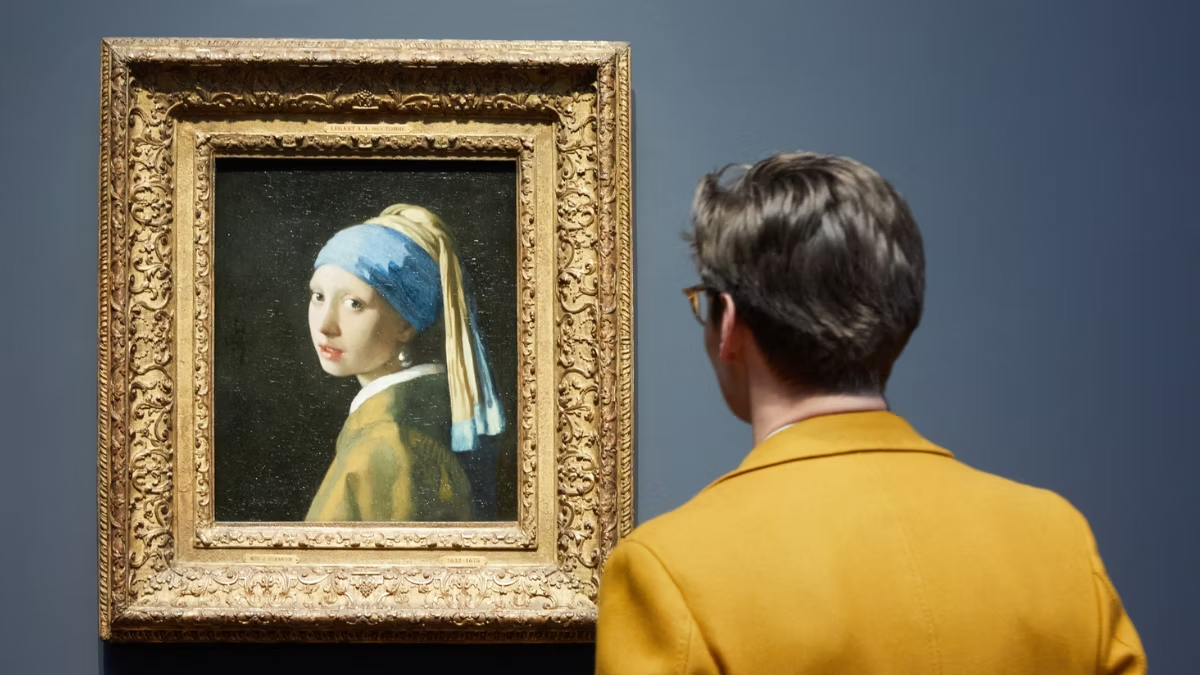
The Milkmaid (c. 1658-1659) by Johannes Vermeer is one of the most famous Dutch Golden Age paintings and one of only 34 known Vermeer works in existence. It depicts a servant woman carefully pouring milk from a pitcher into a bowl, in a plain kitchen interior bathed in light from a window on her left. The painting is surprisingly small — just 45.5 × 41 cm (about 18 × 16 inches) — despite its enormous reputation. It hangs in the Gallery of Honour on Floor 2 of the Rijksmuseum, alongside three other Vermeers. The Milkmaid is the second most-viewed painting in the museum after The Night Watch, but visitors often miss how small it is until they get close.
The Milkmaid is the painting most people mean when they say “Vermeer.” Its quiet, almost still composition — a woman pouring milk in a plain room — has become one of the defining images of the Dutch Golden Age and one of the most reproduced artworks in the world. This guide covers what you’re actually looking at, the painting’s history and symbolism, exactly where it is in the museum, and how to see it with less crowding than the famously packed Gallery of Honour usually delivers.
What Is The Milkmaid?
The Milkmaid is a genre painting (a scene of everyday domestic life) by Johannes Vermeer (1632-1675), painted around 1658-1659 when Vermeer was in his mid-20s. It shows a young servant woman in a plain kitchen pouring milk from a ceramic pitcher into an earthenware bowl on a table. She wears a yellow bodice, blue apron, and white cap. The scene is lit by a window on her left, which is one of Vermeer’s signature compositional devices. Despite its calm ordinariness, the painting is considered one of the supreme achievements of Dutch Golden Age art for its precision of light, colour, and atmosphere.
Key facts at a glance
| Fact | Detail |
|---|---|
| Title | The Milkmaid (De Melkmeid in Dutch) |
| Artist | Johannes Vermeer (1632-1675) |
| Date | c. 1658-1659 |
| Medium | Oil on canvas |
| Dimensions | 45.5 × 41 cm (17.9 × 16.1 inches) |
| Location | Gallery of Honour, Floor 2, Rijksmuseum |
| Acquired by Rijksmuseum | 1908 |
| Previous owner | Six family (Dutch patrician family) who owned it for over 200 years |
| Access | Included with standard Rijksmuseum entry ticket |
How small it actually is
Most visitors are surprised by how small The Milkmaid is in person. The painting is about the size of a standard sheet of A3 paper. This small scale is typical of Vermeer — of his 34 surviving paintings, most are under 60 cm in either dimension. The small scale is part of the intimacy of Vermeer’s work: these aren’t grand civic statements like The Night Watch, but private, contemplative pieces meant to be viewed up close.
Where to Find The Milkmaid
The Milkmaid hangs in the Gallery of Honour on Floor 2 of the Rijksmuseum, in one of the alcoves dedicated to Vermeer. From the Rijksmuseum entrance on Floor 0, take the stairs or lift up two flights. Enter the Great Hall, walk into the Gallery of Honour, and the Vermeer alcove is one of the first you’ll reach — typically the second or third alcove on your left as you walk toward the Night Watch Room. All four Vermeers at the Rijksmuseum are hung close together in the same section.
Navigation step by step
- Enter the museum on Floor 0 (the main atrium)
- Take the staircase or lift up two floors to Floor 2
- Enter the Great Hall (Voorhal) — the ornate entryway with stained glass
- Walk into the Gallery of Honour (Eregalerij) — a long gallery with alcoves on both sides
- The Vermeer alcove is near the front of the gallery — typically the first or second alcove as you walk from the Great Hall toward the Night Watch Room
- The Milkmaid is the most famous of the four Vermeers — it’s the focal painting of the alcove
See Rijksmuseum Floor Plan & Map for the full layout.
The four Vermeers hung together
The Rijksmuseum owns four of the 34 surviving Vermeer paintings, making it one of the two most important Vermeer collections in the world (alongside the Mauritshuis in The Hague). The four at the Rijksmuseum are:
- The Milkmaid (c. 1658-1659) — the most famous
- The Little Street (c. 1658) — a view of a canal house in Delft, Vermeer’s home town
- Woman Reading a Letter (c. 1663) — a woman in blue reading a letter by a window
- Woman with a Water Pitcher (c. 1664) — on long-term loan from the Metropolitan Museum of Art, New York
All four hang in the same section of the Gallery of Honour, typically within a few metres of each other. This density of Vermeers is unmatched outside a major special exhibition.
What to Look For in the Painting
The composition
Vermeer paints the milkmaid at her everyday task — but nothing about the painting is casual. Every element is deliberately placed:
- The window on the left — light source, and one of Vermeer’s signature devices across most of his paintings
- The woman’s gaze — focused on the bowl and the stream of milk, not looking at the viewer
- The milk stream itself — a tiny, precisely-painted ribbon of white falling into the bowl
- The bread and earthenware on the table — a still life within the scene
- The blue apron — made with natural ultramarine, the most expensive pigment of the era, ground from lapis lazuli imported from Afghanistan
- The yellow bodice — lead-tin yellow, a high-status pigment
- The nail in the whitewashed wall above the woman’s head — a detail conservation studies have shown Vermeer used as a compositional anchor
What’s actually on the table
The table setting is a still life in itself:
- A woven basket of bread
- A simple earthenware pitcher from which she’s pouring
- An earthenware bowl receiving the milk — probably for a bread-and-milk pudding, a common Dutch peasant food
- A blue-rimmed jug (behind)
The food suggests the milk is being used to make a dish called brodium or melksop — stale bread soaked in warm milk.
The cupid tile at the bottom
Behind the milkmaid, at floor level, is a row of delft tiles. One tile shows Cupid with a bow. The symbolism is deliberate — 17th-century Dutch genre paintings often contained moral commentary, and milkmaids in Dutch painting had a complicated reputation (often portrayed as sexually available in contemporary art). By putting Cupid behind her, Vermeer is commenting on the tradition — but his milkmaid is painted as virtuous and focused, rejecting the typical lascivious depiction. It’s Vermeer reframing a genre cliché.
The technical brilliance
Three things that reward close study:
- The pointillé dots. Vermeer created highlights by adding tiny white dots of paint. Look closely at the bread, the basket, and the bowl — you’ll see beads of light Vermeer painted as dots rather than smooth gradients.
- The impossibly precise light. The window light on the woman’s arm, the gleam on the pitcher, the soft shadow on the wall — Vermeer’s understanding of how light behaves is centuries ahead of his contemporaries.
- The compositional geometry. Vermeer uses a diagonal running from the window, through the milk stream, to the lower right corner — a stable, triangular composition that makes the scene feel unshakeably calm.
How to See The Milkmaid Without the Crowds
The Gallery of Honour becomes crowded between 10:30 AM and 3:00 PM on most days and genuinely packed on weekends. To see The Milkmaid properly:
Best options:
- 9:00 AM opening slot — the single best time. Walk directly from the entrance up to Floor 2 and the Gallery of Honour will be nearly empty for the first 15-20 minutes.
- Weekday mornings (Tuesday-Thursday) — noticeably quieter than weekends
- Last 30 minutes before closing — the gallery thins as tour groups leave
To get closer to the painting:
- Vermeer is small. To appreciate the pointillé dots, the ultramarine apron, and the cupid tile, you need to be within a metre of the painting.
- The alcove design means only 3-4 people can comfortably stand at close-view distance at once.
- Peak times mean waiting your turn at the front.
The Painting’s History
The Milkmaid was painted around 1658-1659 and passed through private Dutch collections for over 200 years before the Rijksmuseum acquired it in 1908. It was owned by the Six family, a Dutch patrician lineage, for most of the 18th and 19th centuries — famously refused for sale by the family for generations until they sold it to the Dutch state in 1908. The acquisition required a public subscription campaign to raise the purchase price (170,000 guilders — roughly €1-2 million in modern money), and its arrival at the Rijksmuseum was a national cultural event.
Provenance timeline
- c. 1658-1659 — Vermeer paints it in Delft
- 1696 — sold at auction for 175 guilders (approximately €10,000 today)
- Mid-18th century onward — held by the Six family of Amsterdam
- 1908 — acquired by the Rijksmuseum via a national fundraising campaign
- Present — on permanent display in the Gallery of Honour
Why it stayed in the Netherlands
In the early 1900s, there was genuine concern that The Milkmaid would be sold abroad (probably to American collectors, who were actively buying European old masters). The 1908 Rijksmuseum acquisition was a deliberate act of cultural preservation, and the painting has been considered a national treasure ever since.
Vermeer and the Dutch Golden Age
Johannes Vermeer (1632-1675) lived his entire life in the small city of Delft. He painted slowly — only about 34 surviving paintings, possibly a few more lost — and died in poverty at age 43, leaving his wife and 11 children in debt. His reputation collapsed after his death and he was largely forgotten for two centuries.
Vermeer was rediscovered in the mid-19th century by French art critic Théophile Thoré-Bürger, who published the first scholarly study of his work. By the early 20th century, Vermeer was considered one of the supreme painters in Western art history — a reputation that has only strengthened since.
The Milkmaid is considered one of his four or five masterpieces, alongside:
- Girl with a Pearl Earring (Mauritshuis, The Hague)
- View of Delft (Mauritshuis, The Hague)
- The Art of Painting (Kunsthistorisches Museum, Vienna)
- The Geographer (Städel Museum, Frankfurt)
See Vermeer at the Rijksmuseum: All Four Paintings for the full collection overview.
The Milkmaid in Popular Culture
The painting has become one of the most reproduced artworks in the world:
- Nestlé and other dairy brands have used the image (or versions of it) in advertising for over a century
- Featured in countless books about Dutch art, Vermeer, and European painting
- Reproduced in every major museum gift shop — the Rijksmuseum shop alone sells The Milkmaid merchandise from postcards to Playmobil figures
- Referenced in fiction — including Tracy Chevalier’s novel Girl with a Pearl Earring, though that novel focuses on a different Vermeer
- Travelled internationally — in recent decades, lent for major exhibitions at the Met, the National Gallery (London), and the 2023 blockbuster Vermeer exhibition at the Rijksmuseum itself, which drew over 650,000 visitors
Frequently Asked Questions
Where is The Milkmaid by Vermeer displayed?
In the Gallery of Honour on Floor 2 of the Rijksmuseum in Amsterdam, hung alongside the museum’s three other Vermeers.
How big is The Milkmaid painting?
45.5 × 41 cm (approximately 18 × 16 inches) — roughly the size of a sheet of A3 paper. It’s surprisingly small given its fame.
When did Vermeer paint The Milkmaid?
Around 1658-1659, when Vermeer was in his mid-20s. It’s one of his earliest mature masterpieces.
Is The Milkmaid free to see?
It’s included with any standard Rijksmuseum entry ticket (€25 adult, free for under-18s). No separate ticket is required.
How many Vermeers does the Rijksmuseum have?
Four: The Milkmaid, The Little Street, Woman Reading a Letter, and Woman with a Water Pitcher (the last on long-term loan from the Met). All four hang together in the Gallery of Honour. Only the Mauritshuis in The Hague has a comparable concentration of Vermeers.
How many Vermeer paintings exist in total?
About 34 surviving paintings are attributed to Vermeer. There may be a few more lost or unknown works, but the recognised body of work is remarkably small.
What does The Milkmaid symbolise?
The painting plays with 17th-century Dutch tradition of depicting milkmaids as sexually available, reframing the trope by painting a focused, virtuous woman at her work. The Cupid tile behind her references the tradition while the composition rejects it. Beyond this, the painting is read as a meditation on everyday labour, domestic virtue, and the dignity of ordinary work.
Can I photograph The Milkmaid?
Yes — handheld personal photography without flash is permitted throughout the Rijksmuseum. Tripods, selfie sticks, and flash are prohibited. See Rijksmuseum Photography Rules.
Is The Milkmaid the most famous painting at the Rijksmuseum?
It’s the second most famous after Rembrandt’s The Night Watch. The two are often discussed together as the museum’s flagship works.
How much is The Milkmaid worth?
Like The Night Watch, the painting is owned by the Dutch state and will never be sold — so it has no official market value. Insurance estimates range in the hundreds of millions of euros, but these are speculative.
When is the best time to see The Milkmaid without crowds?
The 9:00 AM opening slot on a weekday (Tuesday-Thursday) gives you close access with minimal crowding. The Gallery of Honour becomes densely crowded from 10:30 AM through 3:00 PM, especially on weekends.
Can I download a high-resolution image of The Milkmaid?
Yes — for free. The Rijksmuseum publishes high-resolution images of its entire collection on Rijksstudio (rijksmuseum.nl/en/rijksstudio), downloadable without copyright restrictions. The Milkmaid is among the most-downloaded images on the platform.
