
Battle of Waterloo Painting (2026): Pieneman's Masterpiece at the Rijksmuseum
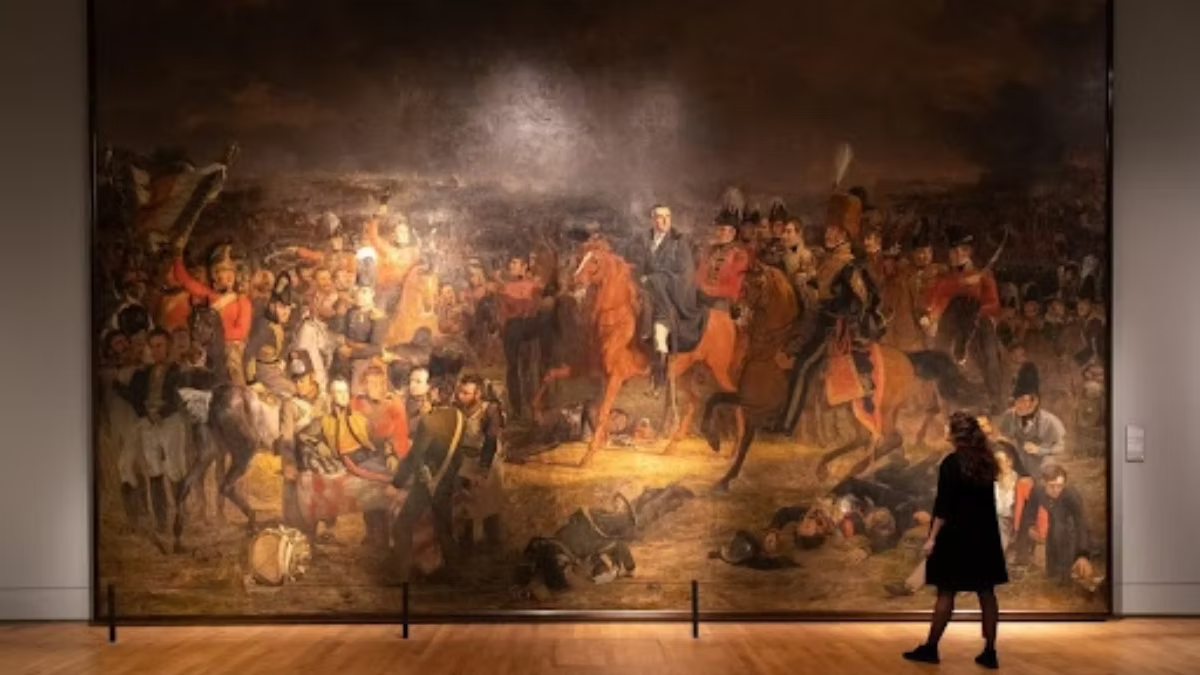
The Battle of Waterloo (1824) by Dutch painter Jan Willem Pieneman (1779-1853) is one of the largest paintings in the Rijksmuseum — a monumental 567 × 823 cm history painting depicting the decisive moment of the 1815 battle where the Duke of Wellington learned that Marshal Blücher’s Prussian forces had arrived to turn the tide against Napoleon. The painting hangs on Floor 1 in a dedicated gallery, well away from the Gallery of Honour crowds. Pieneman spent 4 years (1820-1824) on the work, travelling to London to paint Wellington from life, and the finished canvas was immediately recognised as the defining Dutch image of the Napoleonic wars. Free to see with standard Rijksmuseum entry (€25 adult, free under 18). Often missed by visitors who stay on Floor 2 for the Golden Age galleries.
Most Rijksmuseum visitors never see the Battle of Waterloo. It’s on Floor 1 — not the Golden Age floor — and doesn’t appear on most highlights lists. But it’s a genuine masterpiece of 19th-century history painting, one of the largest canvases in the museum, and a direct window into how the Dutch remembered the Napoleonic wars just a decade after they ended. This guide covers what the painting shows, why it was commissioned, where to find it, and why it deserves your attention.
What Is The Battle of Waterloo?
The Battle of Waterloo is a monumental oil painting by Dutch history painter Jan Willem Pieneman, completed in 1824 — nine years after the actual battle. It measures 567 × 823 cm (roughly 18.5 × 27 feet), making it one of the largest paintings in the Rijksmuseum. The painting depicts a specific moment in the late afternoon of 18 June 1815: the Duke of Wellington receiving word that Prussian Marshal Blücher’s forces had arrived on the battlefield — the turning point that would lead to Napoleon’s final defeat. Over 50 identifiable figures fill the canvas, including Wellington, Blücher’s messenger, Dutch Prince William II (wounded), and numerous Allied officers. It’s a work of propagandistic nation-building as much as history painting — commissioned to cement the Netherlands’ place in the Allied victory.
Key facts at a glance
| Fact | Detail |
|---|---|
| Title | The Battle of Waterloo (De Slag bij Waterloo) |
| Artist | Jan Willem Pieneman (1779-1853) |
| Date completed | 1824 |
| Medium | Oil on canvas |
| Dimensions | 567 × 823 cm (about 18.5 × 27 feet) |
| Subject | The moment Wellington learned of Blücher's arrival, 18 June 1815 |
| Location | Floor 1, dedicated gallery |
| Commissioned by | King William I of the Netherlands |
| Access | Included with standard Rijksmuseum entry |
The scale surprise
Photos don’t convey the scale. At 5.67 metres tall and 8.23 metres wide, the painting is substantially larger than The Night Watch (363 × 437 cm). Standing in front of it, the figures are close to life-size. The composition is designed to be viewed from a distance of 8-12 metres — the museum’s gallery layout accommodates this.
Where to Find the Painting
The Battle of Waterloo hangs on Floor 1 of the Rijksmuseum in a gallery dedicated to 19th-century Dutch history painting. From the main atrium on Floor 0, take the stairs or lift up one floor to Floor 1. The painting is in one of the larger galleries — look for a room with other large-scale history paintings. The Rijksmuseum’s signage includes the Battle of Waterloo gallery on its floor maps. Most visitors find it by following the “Battle paintings” or “19th century” directional signs.
Navigation step by step
- Enter the museum on Floor 0 — main atrium
- Take the stairs or lift up one floor to Floor 1
- Follow signs for “19th century” or “Battle paintings” — the gallery is part of the 19th-century historical painting display
- The Battle of Waterloo is the largest painting in the room — impossible to miss
See Rijksmuseum Floor Plan & Map.
Why the gallery is quieter than Floor 2
Almost every tour group and most self-guided visitors head straight to Floor 2 for The Night Watch and the Vermeers. The 19th-century galleries on Floor 1 see a fraction of the traffic — often you’ll have the Battle of Waterloo room nearly to yourself, even at peak times.
What the Painting Shows
The historical moment
The painting depicts a very specific scene from the late afternoon of 18 June 1815 — the day of the battle itself. By 6 PM, the fighting had been grinding on for 10 hours. Wellington’s Anglo-Allied army was exhausted but still holding against Napoleon’s French forces. The battle’s outcome was genuinely uncertain.
Then, Prussian Marshal Gebhard von Blücher’s army arrived from the east, having fought their way through roads mud-choked by morning rain. Blücher’s 50,000 fresh troops tipped the balance decisively. Napoleon’s last reserve — the Imperial Guard — was thrown in and broken. Within two hours, the French were in full retreat.
Pieneman paints the exact moment Wellington learned of Blücher’s arrival. A Prussian messenger (on the right side of the canvas) has just delivered the news. Wellington (centre-left, on his horse Copenhagen) turns to respond, his staff officers around him reacting with a mix of relief and urgency.
The central figures
Wellington dominates the composition — mounted on his horse Copenhagen, dressed in the dark blue British officer’s coat he wore at the battle. His posture is calm and decisive, the model of leadership under pressure. Pieneman travelled to London in 1821 to paint Wellington from life — a rare opportunity that gives the figure unusual authenticity.
Prince William of Orange (the future King William II of the Netherlands) appears in the foreground, being carried wounded from the field. He was shot in the shoulder earlier in the battle. His prominent inclusion is deliberate: the painting’s Dutch royal patron wanted the Netherlands’ contribution to the Allied victory emphasised.
The Prussian messenger delivering news of Blücher’s arrival — the moment’s narrative hinge.
Fallen French cuirassiers, Scots Greys cavalry, British infantry squares — over 50 identifiable figures, many painted from life or from known portraits.
The composition
Pieneman organises the massive canvas around clear visual anchors:
- Wellington on horseback — the obvious focal point, slightly left of centre
- The wounded Prince William — lower foreground, drawing the eye forward
- Distant battle smoke and French retreat — upper right, suggesting victory beyond the immediate frame
- Fallen bodies in the foreground — lower left, the cost of the day
- The Prussian flag and arriving forces — right side, the decisive reinforcement
The composition pulls your eye across the canvas in a rough “V” — Wellington and staff on the left, the action and arrivals on the right, the wounded and dead in the centre foreground.
Who Was Jan Willem Pieneman?
Jan Willem Pieneman (1779-1853) was the leading Dutch history painter of the early 19th century. Born in Abcoude near Amsterdam, he trained initially as a house painter before turning to fine art. He became the director of the Royal Academy of Fine Arts in Amsterdam and the preferred history painter of the Dutch royal family following the creation of the Kingdom of the Netherlands in 1815. The Battle of Waterloo was his defining work — a four-year project commissioned directly by King William I to commemorate the Dutch role in defeating Napoleon. His son Nicolaas Pieneman continued the family tradition as a history painter.
Pieneman’s career in context
Pieneman worked in a specific historical moment:
- 1815 — the Kingdom of the Netherlands was created, uniting the formerly separate Dutch Republic with Belgium
- 1815-1830 — the young kingdom needed symbols and narratives to cement its identity
- History painting — the most prestigious and politically useful genre
- Pieneman — became the semi-official state painter of this nation-building period
How he researched the painting
Pieneman approached the Battle of Waterloo with unusual rigor:
- 1820 — began work on the commission
- 1821 — travelled to London to meet Wellington and paint him from life over several sittings
- 1821-1823 — studied uniforms, weapons, and military records from the battle
- Interviewed veterans who had fought at Waterloo, including Dutch officers
- Made detailed preparatory drawings of individual figures and compositional studies
- 1824 — completed the final canvas
This level of research was exceptional for the time and gives the painting its distinctive quality of historical specificity — unlike many romantic battle paintings, this one documents rather than mythologises.
The Political Context
The Battle of Waterloo wasn’t just a painting — it was an act of statecraft.
Why King William I commissioned it
When the Kingdom of the Netherlands was created at the Congress of Vienna in 1815, the new state’s legitimacy needed visual reinforcement. King William I had ruled as sovereign of the Netherlands for less than a decade. The country needed heroic founding narratives — and Waterloo was the obvious choice.
The painting was commissioned to:
- Establish Dutch military credibility — showing Prince William of Orange personally wounded in the fight
- Anchor the young kingdom in the Allied coalition victory — the Dutch as partners of Wellington and Blücher, not as Napoleon’s former satellites
- Provide a ceremonial image for public display — originally hung at Soestdijk Palace and other royal residences before transfer to the Rijksmuseum
Why this specific moment?
The “Blücher arriving” moment was chosen carefully:
- It shows turning of the tide — not the chaos of battle, but the moment of certain victory
- It centres Wellington as the Allied commander-in-chief
- It makes the Dutch contribution visible — the wounded Prince William in the foreground
- It minimises actual fighting — no bayonet-level violence; the tone is controlled and heroic
Compare with Romantic battle paintings by French artists of the same era, which often showed dramatic chaos, dying soldiers, and Napoleonic heroism. Pieneman’s version is deliberately quieter and more “official.”
How to Look at the Painting
Stand back far enough
The composition is designed for viewing at 8-12 metres. Stand back, take in the overall scene, then approach for detail study.
Identify the three zones
- Left zone — Wellington and command staff, the decision-making centre
- Right zone — arriving Prussian forces and the messenger, the narrative catalyst
- Foreground zone — the wounded, the dead, the cost
Study individual portraits
Look for specific identifiable officers. Pieneman painted many figures from life or from known portraits. The Rijksmuseum’s interpretive labels identify several of the central figures by name.
Notice the lighting
Pieneman uses dramatic late-afternoon light from the west — the historically accurate lighting condition for the moment he’s depicting. Shadows fall to the east. This is a rare example of a history painting that gets its light physics right.
Compare with The Night Watch
Both are monumental group compositions by Dutch masters, 182 years apart. Rembrandt’s Night Watch is theatrical and painterly; Pieneman’s Waterloo is documentary and polished. Different genres, different approaches to the same basic challenge — many figures in one canvas.
Why the Painting Matters
19th-century Dutch history painting at its peak
Pieneman represents the best of Dutch early-19th-century history painting. Few other Dutch painters attempted work at this scale and level of research. The painting is a reference point for the entire genre.
A rare surviving historical record
Because Pieneman painted Wellington from life and worked from direct veteran testimony, the painting contains genuine documentary value — details of uniforms, equipment, and specific figures that are historically accurate in ways most battle paintings aren’t.
A case study in state commissioned art
The painting is a clear example of how European governments in the post-Napoleonic era used art to construct national narratives. Understanding this context makes the painting’s political choices visible.
The scale experience
Simply: it’s one of the largest paintings in a world-class museum, and standing in front of it is a different kind of art experience than looking at the smaller works on Floor 2.
How to Fit It Into Your Visit
If you have 2 hours at the Rijksmuseum
You’ll probably skip Floor 1 entirely, including Waterloo. The highlights route focuses on Floor 2 — see Rijksmuseum in 2 Hours: A Self-Guided Route.
If you have 3 hours
Add 15-20 minutes on Floor 1 to see the Battle of Waterloo and some additional 19th-century paintings. The detour is simple — one floor down from the Gallery of Honour.
If you have 4+ hours
Plan a dedicated 45 minutes on Floor 1, exploring the full 19th-century gallery including Waterloo, Dutch history paintings, and portraits of the young kingdom’s royal family.
On a return visit
The Battle of Waterloo is ideal for return visits. On your first trip you prioritise Floor 2; on a return visit, Floor 1 offers a whole different dimension of the museum.
See How Long Do You Need at the Rijksmuseum.
Photography
Handheld photography without flash is permitted. The painting’s scale creates photographic challenges:
- Stand far back to capture the full composition in one frame — 8-12 metres at least
- Portrait orientation rarely works for this painting; use landscape
- Close-ups of individual figures work well — the faces of Wellington and Prince William are particularly rewarding
- Avoid crowds in the frame — less of an issue here than in the Gallery of Honour
The Rijksmuseum’s Rijksstudio platform (rijksmuseum.nl/en/rijksstudio) offers the full painting in high-resolution free download.
See Rijksmuseum Photography Rules.
Related Paintings and Context
For visitors interested in the Battle of Waterloo specifically:
Elsewhere in the Rijksmuseum
- Portraits of Dutch royal family members on Floor 1 — including King William I and the wounded Prince William
- Other Napoleonic-era paintings in nearby galleries — Dutch artists responding to the era
- Nicolaas Pieneman’s works — Jan Willem’s son also painted Dutch royal and historical subjects
Elsewhere in the Netherlands
- Waterloo battlefield itself — 30 minutes south of Brussels, Belgium. The Butte du Lion monument, the battlefield panorama, and museums dedicated to the battle.
- Paleis Het Loo, Apeldoorn — royal palace with additional Pieneman works and Waterloo-related material
- Army Museum (Legermuseum), Soesterberg — uniforms, weapons, and artifacts from the battle
Other major Waterloo paintings worldwide
- Louis-François Lejeune’s Waterloo paintings — French perspective, now in various museums
- Sir William Allan’s “The Battle of Waterloo” (1843) — at Apsley House, London
- Clément-Auguste Andrieux’s “Charge of the Cuirassiers at Waterloo” — in the Musée de l’Armée, Paris
Pieneman’s version is unusual for its neutral-historical tone compared to the more romantic approaches of French and British painters.
Frequently Asked Questions
Where is the Battle of Waterloo painting at the Rijksmuseum?
On Floor 1 in the 19th-century history painting gallery. Take the stairs or lift up one floor from the main atrium and follow signs for “Battle paintings” or “19th century.”
Who painted the Battle of Waterloo at the Rijksmuseum?
Jan Willem Pieneman (1779-1853), the leading Dutch history painter of the early 19th century. He completed the painting in 1824 after four years of work including travel to London to paint Wellington from life.
How big is the Battle of Waterloo painting?
567 × 823 cm (approximately 18.5 × 27 feet) — one of the largest paintings in the Rijksmuseum, substantially bigger than The Night Watch (363 × 437 cm).
When was the Battle of Waterloo painted?
Completed in 1824, nine years after the actual battle on 18 June 1815. Pieneman began work in 1820 and spent four years on the painting.
Why did Pieneman paint the Battle of Waterloo?
It was commissioned by King William I of the Netherlands to commemorate the Dutch role in defeating Napoleon at Waterloo. The painting served a political purpose — establishing the young Kingdom of the Netherlands (created in 1815) as a major Allied power and emphasising the wounded Prince William of Orange’s contribution.
What moment does the painting show?
The late afternoon of 18 June 1815, when the Duke of Wellington receives word that Prussian Marshal Blücher’s forces have arrived to reinforce the Allied position. This was the turning point that ensured Napoleon’s defeat.
Is the Battle of Waterloo painting historically accurate?
Remarkably so for the genre. Pieneman travelled to London to paint Wellington from life, interviewed Dutch veterans of the battle, studied uniforms and weapons from the period, and researched military records. The result is unusually documentary for a 19th-century history painting.
Who are the main figures in the painting?
The Duke of Wellington (Allied commander-in-chief, on horseback, centre-left), Prince William of Orange (wounded in the foreground, future King William II of the Netherlands), the Prussian messenger announcing Blücher’s arrival (right side), and over 50 other identifiable officers including fallen French cavalry and British infantry.
Is the Battle of Waterloo included in the standard Rijksmuseum ticket?
Yes. The painting is on Floor 1 and included with any standard €25 adult entry ticket (free for under-18s). No separate booking or additional cost.
Can I photograph the Battle of Waterloo?
Yes. Handheld personal photography without flash is permitted. The painting’s scale means you’ll need to stand 8-12 metres back to capture it fully. See Rijksmuseum Photography Rules.
Why isn’t this painting more famous?
Two reasons: (1) it’s on Floor 1, not Floor 2 where most visitors concentrate; (2) 19th-century history painting is out of fashion globally — the genre fell from critical favour after Impressionism, and major history paintings like this one are appreciated by specialists more than by general audiences. The painting deserves more attention than it gets.
How long should I spend looking at the Battle of Waterloo?
10-15 minutes for a proper engagement — stand back for the overall composition, then approach for detail study of individual figures. Visitors who are particularly interested in military history or 19th-century art can spend 20-30 minutes.
Are there other Pieneman paintings at the Rijksmuseum?
Yes — several other Jan Willem Pieneman works are in the Rijksmuseum collection, including additional royal portraits and historical scenes. His son Nicolaas Pieneman is also represented. Check the museum’s online catalogue for what’s currently on display.
