
The Asian Pavilion at the Rijksmuseum (2026): Collection, Highlights & Guide
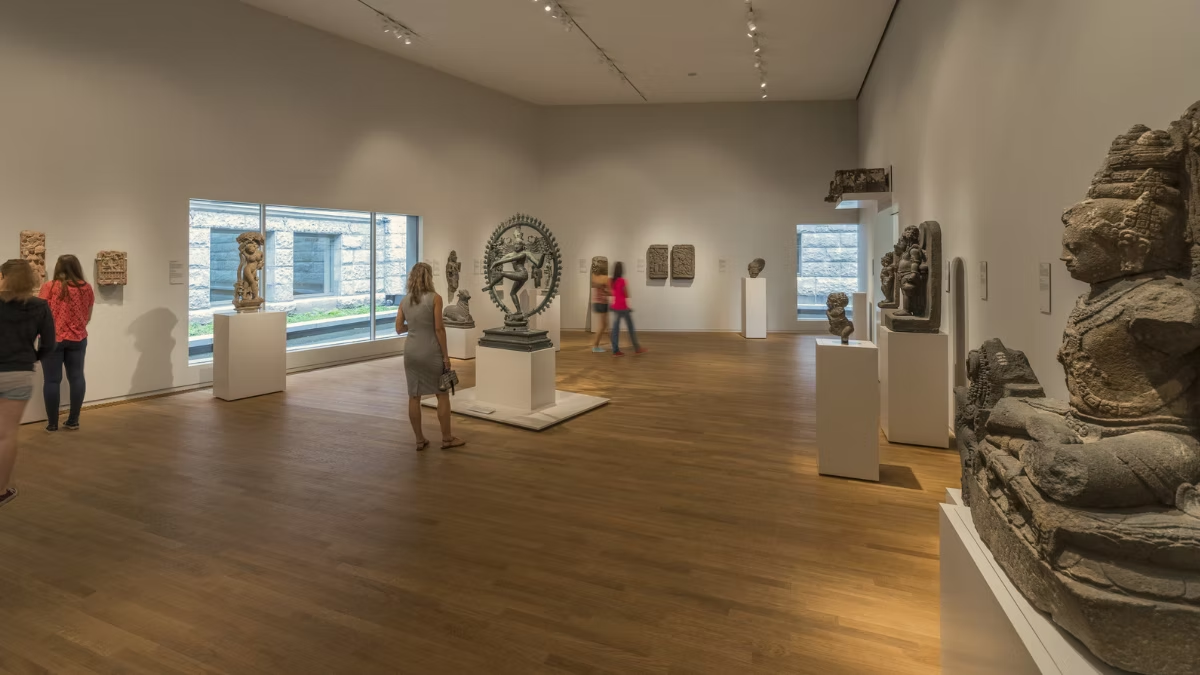
The Asian Pavilion is a separate, free-standing wing of the Rijksmuseum dedicated to Asian art — the only part of the museum that isn’t connected to the main Cuypers building. Opened in 2013 as part of the major museum renovation, designed by Spanish architects Cruz y Ortiz, it displays approximately 365 objects from across Asia — Chinese ceramics, Japanese prints and armour, Indonesian bronzes, Indian sculpture, Korean ceramics, and Vietnamese lacquerware. The pavilion is reached via the main atrium (Floor 0) through a glass walkway, and most visitors either skip it entirely or rush through after seeing the Golden Age galleries. Worth 30-60 minutes for anyone interested in Asian art, Buddhist sculpture, or Dutch colonial history. Free with standard Rijksmuseum entry (€25 adult, free under 18).
The Asian Pavilion is the Rijksmuseum’s best-kept secret — a genuinely excellent Asian art collection that most visitors miss because they’re focused on the Dutch Golden Age. The pavilion was added in the 2013 renovation and houses one of Europe’s better collections of Asian decorative and religious art. This guide covers what you’ll find, how to get there, and why it’s worth the detour even if you came to the Rijksmuseum primarily for Rembrandt and Vermeer.
What Is the Asian Pavilion?
The Asian Pavilion is a purpose-built wing added to the Rijksmuseum during the 2013 renovation, designed by Cruz y Ortiz (the Spanish architectural firm that also led the main museum renovation). It’s physically separate from the Cuypers building — a modern, low-profile structure connected to the main atrium via a glass-sided walkway. The pavilion displays approximately 365 objects spanning 4,000 years of Asian art, drawn from the Rijksmuseum’s Asian collection of over 5,000 objects (most kept in storage and rotated through exhibitions). Collection strengths include Chinese export porcelain, Japanese Edo-period prints, Southeast Asian bronzes and sculpture, and Indian decorative arts — many acquired during the Dutch East India Company era.
Key facts at a glance
| Fact | Detail |
|---|---|
| Opened | 2013 (during the major Rijksmuseum renovation) |
| Architect | Cruz y Ortiz (Spanish firm) |
| Location | Separate wing, accessed via glass walkway from main atrium |
| Objects on display | ~365 |
| Total Asian collection | ~5,000 objects (most in storage) |
| Cultures represented | China, Japan, Korea, India, Indonesia, Vietnam, Thailand, Tibet, Afghanistan, others |
| Access | Included with standard Rijksmuseum entry |
Where to Find the Asian Pavilion
The Asian Pavilion is accessed from the main atrium on Floor 0 of the Rijksmuseum. Look for signs reading “Asian Pavilion” or “Aziatisch Paviljoen.” The pavilion is reached via a glass walkway extending from the east side of the main building into the pavilion wing. The pavilion itself has two floors — a ground-floor space and an upper gallery. Unlike the main museum, the pavilion’s gallery numbering is its own (not continuous with the main building’s Room 1.13, 2.20, etc.).
Navigation step by step
- Enter the museum on Floor 0 — main atrium
- Instead of heading up to Floor 2 (where most visitors go), stay on Floor 0
- Look for signs to the Asian Pavilion — typically on the east or south side of the atrium
- Walk through the glass connecting corridor — brief, maybe 30-40 metres
- Enter the pavilion proper — two floors of galleries
The pavilion is genuinely easy to miss because the signage is less prominent than the main Gallery of Honour routes and because most tour groups don’t include it.
See Rijksmuseum Floor Plan & Map.
What’s in the Collection
Chinese objects (the largest national collection)
The Chinese section is the pavilion’s largest. Key items:
- Export porcelain — blue-and-white wares made specifically for European markets during the 17th-19th centuries
- Ming and Qing dynasty pieces — vases, plates, dragon figures, ritual objects
- Buddhist sculpture — stone, bronze, and wooden figures of Buddhas and bodhisattvas
- Bronze ritual vessels — ancient ceremonial objects
- Jade carvings — ornamental and religious objects
- The Dancing Shiva — one of the pavilion’s signature pieces (though this is Indian, not Chinese; see below)
Japanese objects
The Japanese collection reflects the unusual Dutch-Japanese relationship — the Dutch were the only Europeans permitted to trade with Japan during the Edo period’s 200-year isolation (1639-1853). Key items:
- Edo-period woodblock prints — by Hokusai, Hiroshige, and others
- Samurai armour and weapons — full sets of ceremonial and battle armour
- Lacquerware — elaborately decorated boxes and screens
- Ceramics — tea ceremony wares, Kakiemon porcelain, Imari export wares
- Netsuke and inro — miniature carved objects from Edo-period Japan
Indonesian and Southeast Asian objects
Acquired primarily during Dutch colonial rule (1602-1949). Key items:
- Javanese bronze sculpture — Hindu-Buddhist deities from 9th-14th century
- Wayang puppets — shadow puppets used in traditional Javanese theatre
- Ritual daggers (keris) — elaborately decorated Indonesian ceremonial weapons
- Textiles — batik, ikat, and other traditional fabrics
Indian and South Asian objects
- Mughal-period decorative arts — miniature paintings, metalwork, jade
- Hindu and Buddhist sculpture — stone and bronze religious figures
- The Dancing Shiva (Nataraja) — an 11th-12th century bronze of Shiva dancing in the ring of fire; widely considered one of the pavilion’s most important pieces
Other cultures
Smaller but significant holdings from:
- Korea — ceramics, furniture, folk art
- Vietnam — lacquerware, ceramics
- Thailand and Cambodia — Buddhist sculpture
- Tibet and Central Asia — religious art, textiles
The Signature Pieces
The Dancing Shiva (Nataraja)
11th-12th century bronze, South Indian (Chola dynasty). Approximately 80 cm tall, the sculpture shows Shiva in the cosmic dance that creates and destroys the universe, standing on a dwarf representing ignorance, surrounded by a ring of fire. One of the finest examples of Chola bronze casting outside India.
Guanyin with a Thousand Arms
A large multi-armed Chinese Buddhist sculpture of Guanyin (the bodhisattva of compassion). The Rijksmuseum’s example is 17th-18th century, wooden, painted. Stands approximately 1.5-2 metres tall and commands its own alcove.
Japanese Samurai Armour
Multiple complete armour sets on display, including helmets with elaborate crests, body armour, and weapons. These were collected in the 19th century when European interest in Japan exploded following the country’s reopening to trade.
The Ceiling Painting Room
A reconstructed room from a 17th-century Indonesian merchant’s house with an elaborately painted ceiling, giving context for how collected objects were originally displayed.
Chinese Export Porcelain
A large wall display of Chinese blue-and-white porcelain made for European markets — including pieces marked with European family crests or custom designs. This collection illuminates Dutch East India Company trade.
Why the Pavilion Exists
The Rijksmuseum’s Asian collection was built primarily through the Dutch East India Company (VOC) era (1602-1799) and the Dutch colonial period in Indonesia (1800-1949). This means:
Complicated provenance
Many objects in the pavilion have colonial-era provenance — acquired through trade, tribute, or conquest during Dutch political and commercial expansion. The Rijksmuseum has been increasingly transparent about this history in recent years, with object labels providing context about how pieces entered the collection.
Some ongoing restitution discussions
The pavilion occasionally returns objects to their countries of origin. Notable cases:
- Several Indonesian objects have been returned to Indonesia in recent years
- Research continues on provenance for colonial-era acquisitions
- The museum’s position is that objects with demonstrable illegal or coercive acquisition histories should be returned
This is an evolving area and the pavilion’s collection may shift over time as more objects are identified for restitution.
Architectural Note: Cruz y Ortiz
The Spanish firm Cruz y Ortiz designed both the pavilion and the 2013 renovation of the main Rijksmuseum building. The pavilion’s architecture deliberately contrasts with Cuypers’ 19th-century main building:
- Modern, minimal exterior — dark brick and glass
- Low-profile horizontal mass — sits next to the main building without competing with it
- Abundant natural light via skylights and window walls
- Neutral interior — emphasises objects rather than architecture
- Flexible display systems — can be reconfigured for special exhibitions
The contrast between the ornate Cuypers main building and the restrained modern pavilion is deliberate — and makes the connection walk between them part of the experience.
How Long to Spend
- Quick overview: 20-30 minutes — sufficient to see the highlights
- Typical visit: 45-60 minutes — enough to engage with the major pieces
- Serious engagement: 1.5-2 hours — for visitors specifically interested in Asian art
The pavilion is significantly smaller than the main Rijksmuseum galleries, so even a thorough visit doesn’t take long.
When to Visit the Pavilion
The pavilion is consistently one of the least crowded parts of the Rijksmuseum, so crowd-avoidance is less of a concern than in the Gallery of Honour.
Good options:
- Later morning or early afternoon — after you’ve done the main museum highlights
- End of your visit — before leaving, as a calm conclusion
- On a return visit — if you’ve been to the Rijksmuseum before and want to see something new
Less ideal:
- Right at opening (9:00 AM) — you should use that slot for the Gallery of Honour and Night Watch Room when those are quietest
- Last 30 minutes before closing — you may rush through important pieces
Photography
Handheld photography without flash is permitted throughout the pavilion. Many objects are displayed behind glass, which can introduce reflections. The architectural lighting is typically good for phone cameras. Sculpture pieces photograph especially well — the minimal modern display approach provides clean backgrounds.
See Rijksmuseum Photography Rules.
Who Should Make Time for the Pavilion
- Visitors interested in Asian art — obvious but worth stating
- Visitors on second or third Rijksmuseum trips — you’ve done the main museum; the pavilion adds depth
- Buddhist art enthusiasts — the sculpture collection is significant
- Visitors interested in Dutch colonial history — the objects document 300+ years of Dutch-Asian trade and political relations
- Visitors tired of Golden Age paintings — the pavilion offers a completely different aesthetic register
- Architecture enthusiasts — the Cruz y Ortiz building is itself worth studying
Who Can Skip the Pavilion
- First-time visitors with tight time — the main collection (Rembrandt, Vermeer, Night Watch) takes priority
- Visitors with no interest in Asian art — better to spend that time in the 17th-century galleries
- Very young children — the pavilion requires more quiet attention than the main galleries
- Visitors prioritising Dutch history specifically — the main galleries serve that better
Frequently Asked Questions
Where is the Asian Pavilion at the Rijksmuseum?
It’s a separate building accessed from the main atrium on Floor 0 via a glass walkway. Look for signs reading “Asian Pavilion” or “Aziatisch Paviljoen” in the atrium.
Is the Asian Pavilion included in the standard ticket?
Yes. Access is included with any standard €25 adult entry ticket (free for under-18s). No additional booking or fee is required.
When was the Asian Pavilion built?
2013, as part of the Rijksmuseum’s major 10-year renovation. Designed by the Spanish architectural firm Cruz y Ortiz, who also led the main building’s renovation.
What’s in the Asian Pavilion collection?
Approximately 365 objects on display from across Asia — Chinese ceramics and sculpture, Japanese prints and armour, Indonesian bronzes and textiles, Indian sculpture, Korean ceramics, and more. Highlights include the 11th-12th century bronze Dancing Shiva, Guanyin Buddhist sculptures, and Edo-period Japanese woodblock prints.
Is the Dancing Shiva at the Asian Pavilion?
Yes. The pavilion’s South Indian Chola-dynasty bronze Nataraja (11th-12th century) is one of the signature pieces — approximately 80 cm tall, showing Shiva in cosmic dance.
How long should I spend in the Asian Pavilion?
30-60 minutes is typical. Visitors specifically interested in Asian art can spend 1.5-2 hours; quick overviews are possible in 20-30 minutes. The pavilion is small enough that it doesn’t dominate a half-day Rijksmuseum visit.
Can I photograph the Asian Pavilion?
Yes. Handheld photography without flash is permitted. Many objects are in glass cases with some reflections; the minimal modern display architecture provides good photo backgrounds for sculpture pieces.
Is the Asian Pavilion crowded?
Usually not. It’s consistently one of the least crowded parts of the Rijksmuseum. Most tour groups skip it entirely, which makes it a calm alternative to the Gallery of Honour.
Does the pavilion have a specific theme or is it just “Asian”?
It’s organised broadly by region and culture rather than a single theme. You’ll encounter Chinese, Japanese, Korean, Indian, Indonesian, and Southeast Asian objects in distinct areas. Some objects are organized by material (ceramics together, sculpture together) or function (religious objects, domestic objects).
How does the Asian Pavilion collection relate to Dutch history?
Most objects were acquired during the Dutch East India Company era (1602-1799) or the Dutch colonial period in Indonesia (1800-1949). The pavilion’s collection reflects 300+ years of Dutch trade and political engagement with Asia. In recent years, the Rijksmuseum has been increasingly transparent about colonial-era provenance and has returned some objects to their countries of origin.
Are there guided tours of the Asian Pavilion?
The Rijksmuseum’s standard guided tours typically don’t include the Asian Pavilion (tours focus on Dutch Golden Age). If you want expert commentary on the Asian collection, consider a private tour with a request to focus on or include Asian art.
